Founding ML Engineer, Underwater Acoustic Intelligence
The ocean is the last unmonitored domain. The cables, pipelines, and wind farms that Europe runs on sit in water nobody is listening to. Nord Stream, the Baltic cable cuts, repeated incursions around critical infrastructure. The threats stopped being hypothetical a long time ago. The gap between what operators can see above water and what is actually happening below it has become impossible to ignore.
We are closing that gap.
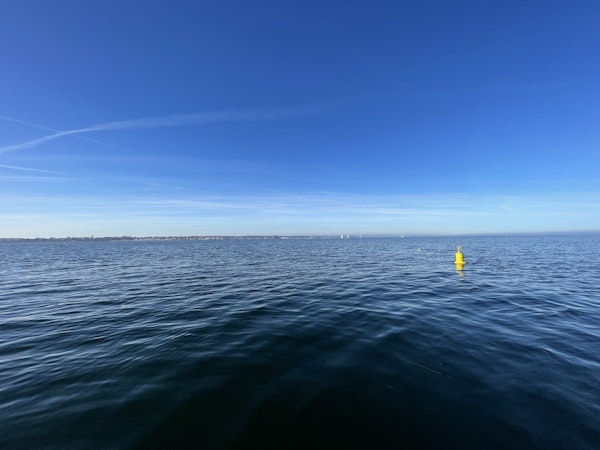
Triton Depth puts intelligence on the water. Our buoys sit on the surface, listen continuously below it, and classify what moves through the water on-device. Divers, autonomous underwater vehicles, vessels behaving in ways they should not. Buoys form a wireless acoustic mesh and relay alerts to shore in real time. Persistent underwater awareness, deployed in days, at a fraction of the cost of legacy sonar.
Done well, this technology saves thousands of lives a year. Naval crews warned before an incursion reaches them. Civilians whose power and heat hold through winter. People in conflict zones where minutes of warning is the difference between a response and a casualty list. The stakes are why we are doing this.
We are looking for the person who will own the intelligence layer. From data collection to actionable intel.
The work
You own the acoustic ML stack end to end. Ingestion from buoys deployed in the water, datastream organization, labeling infrastructure, training, evaluation against operational signal, and deployment back to constrained edge hardware. You decide the architecture. You decide what ships.
The data is unusual and very few people have worked with it at scale. Raw hydrophone streams, noisy, non-stationary, dominated by physics you cannot ignore. Some of the most interesting targets are rare by definition. You will build the pipeline that turns this into models good enough to earn a spot on a buoy that has to live on the water for a year on battery.
You will work in close collaboration with our electronics team. Experience from that world is a real plus, especially if it comes with a record of things you have shipped that worked. Edge-first thinking is not a preference here; it is the entire job. A model that works in a notebook and not on the buoy does not exist. Expect time on boats and quays. The data comes back from the sea, and so will the feedback that tells you whether last week's model earned its place.
Your first 6–9 months
Roughly what the first 6–9 months look like. The data and the hardware already exist, so you can start on real signal from week one.
1. Build the data pipeline. Raw hydrophone streams come off the buoys faster than anyone has labeled them. You design the ingestion, storage, and labeling setup that turns continuous audio into a dataset you can actually train on, and you decide how labeling scales once one person can't keep up.
2. Train the first real classifier. A model that detects and classifies targets in the hydrophone data against a low, noisy baseline, trained and evaluated on our own field recordings rather than a public benchmark. Getting reliable detection out of non-stationary acoustic noise is the core ML problem here.
3. Get it running on the buoy. The model has to fit the buoy's compute, memory, and power budget and run on-device for long stretches without a person in the loop, then relay detections to shore. Closing the gap between a model that works in training and one that holds up on deployed hardware is most of the engineering.
What we care about
Real experience with audio or acoustic machine learning. Computer vision counts too. The instincts transfer, and we need someone who thinks in spectrograms and feature maps with the same fluency.
An edge-first mindset. You have shipped models to hardware with real constraints. Power, latency, memory, all of it. You know what survives quantization and what does not. You have made peace with the fact that the best model is the one that runs.
The ability to organize messy data streams into something a team can actually train on. We have buoys producing data faster than anyone has thought to label it. That pipeline is yours.
Startup energy. You want to ship this week, not next quarter. You are senior enough to architect a system alone and unbothered about labeling data on a Tuesday afternoon when that is what moves the product. You want the leverage of building something from zero more than you want a team to manage. The team comes later, and you will hire it.
Bonus, not required: physical AI experience, sensor fusion, sonar background, prior work in defense or dual-use, anything that says you have already done hard things with messy real-world signal. Maritime experience of any kind is a real plus, whether that is sailing, marine engineering, or anything else that has put you near the water.
We expect a master's in data science, machine learning, or you might just be the GOAT of acoustics.. PhD welcome, not required. Beyond that, we care about what you have shipped.
You might come from somewhere like Spotify, GN, Demant, Terma, Saab, Kongsberg, a defense prime, a university acoustics or audio lab, or a startup we have not heard of yet.
Why now
Two years ago, subsea surveillance was a niche conversation. Today Helsing, Anduril, and the European primes are all building in this space, and the budget that did not exist three years ago is here. The category is real. The window for a small team to own it is open now, and it will not stay open long. We intend to be the company people name when they talk about who owns the water.
You will be employee one on the technical side outside the founding team. The decisions you make in the first 6–9 months will define how this company builds for the next five years. This should not be seen as a position you are in for 2-3 years. This is an opportunity to be an integral part of perhaps Europe’s next giant.
Practical
Location: Copenhagen, on-site. We work in the same room because the early version of this company cannot be built any other way.
Compensation: ~50–65k DKK monthly base. Meaningful founding-team equity agreed at offer.
Start: Summer 2026, as soon as possible.
Citizenship: NATO member state required.
Background check: Final offer contingent on a thorough background check given our defense customer relationships.
How to apply
Send anything that gives us real signal. A repo, a paper, a system you shipped, a teardown of a problem that taught you something useful. A CV is fine, but it is rarely the most interesting thing you can send. Cover letters are very welcome, but PLEASE don’t just throw our linkedIn description into Claude. Give us a reason to pick you from the bunch!
We read everything.
Perks and benefits
This job comes with several perks and benefits

Near public transit

Free office snacks

Equity package

Social gatherings

Gamified office

New tech gear
Working at
Triton Depth