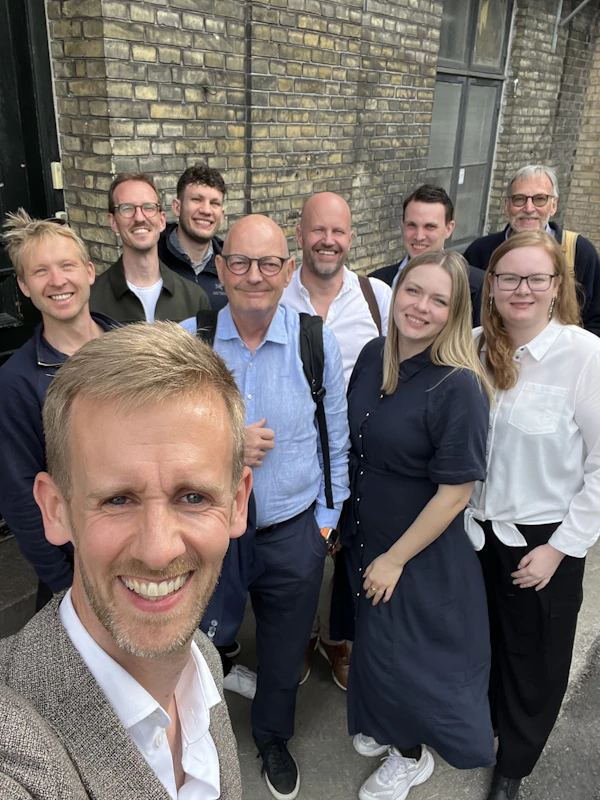
Who We Are
Ventriject is a Danish health tech company. We've built Seismofit®, an award-winning, AI-powered algorithm that estimates cardiorespiratory fitness (VO2max) at rest - no exercise needed - from the tiny chest vibrations produced by each heartbeat. It's patented, and clinically validated against cardiopulmonary exercise testing, the gold standard for measuring VO2max, in peer-reviewed studies. We're a small R&D team working with real clinical data, and we're looking for a student to get their hands on the actual algorithm behind a groundbreaking solution that is supporting health and wellness professionals around the world.
Because we operate in a regulated healthcare market, we build our software to a high standard of quality and testing. You don't need any background in medical device regulation to apply - we'll show you that side as you go. Your focus is the algorithms and the data.
What You'll Be Doing
The work spans data, algorithms, and engineering. Some weeks are mostly cleaning clinical datasets and chasing down file-format quirks from research collaborators, other weeks you're testing a new algorithm idea or watching a model actually move the needle - that's just what real R&D looks like. The mix below will follow your strengths and our needs, and grow over time - we don´t expect you to be doing all of this on day one.
Data: You'll clean and quality-check datasets from our research collaborators, write import scripts that turn inconsistent source formats into something usable, build notebooks that let researchers see what's in the data, and dig for signal features that correlate with VO2max.
Algorithms and models: You'll develop and test algorithms for VO2max estimation, explore where machine learning methods can improve on our current approach, and document your work well enough that someone else - including future-you - can reproduce it.
Engineering and tooling: You'll help set up and maintain our CI/CD and MLOps tooling - experiment tracking, data and model versioning - and write tests that keep the codebase reliable enough to trust with real patient data.
Who we're looking for
The Academic Profile: You're a master's student or 3rd-year bachelor's student in machine learning/AI, biomedical engineering, signal processing, or a related field.
The Technical Toolkit: Solid Python skills, hands-on experience building ML and statistical models (think linear regression, PCA, Bayesian statistics, basic neural networks), and you're comfortable with Git.
The AI-Native Mindset: We won't judge you for using Claude Code, Codex, or other AI agents to help you write code - we expect it. What we care about is that you understand why and how the code works.
The Curious Scientist: You don't need to walk in knowing anything about seismocardiograms or cardiac signals - but a real interest in learning them matters.
Startup Comfort: You're fine with a good deal of self-management, and you've got opinions about how things should be built. We genuinely want to hear them. You'll thrive here if you enjoy the variety of a startup environment, where you collaborate across disciplines on a small, impact-driven team.
Fluent in English: Being an international team, our internal communications are done in English, both written and oral.
Any of the following is a plus, though none is required:
Experience with signal processing or time-series data
Familiarity with ML frameworks and experiment-tracking or model-registry tools (e.g. MLflow, DVC)
Exposure to Matlab
Exposure to CI/CD or MLOps practices
Interest/experience in cardiovascular physiology or cardiorespiratory fitness
More than any single tool, we care that you are curious, eager to learn, and careful with data - and that you can explain what you did and why.
What you'll get
Real Impact: Make real impact with an actual product based on real clinical data .
A Rare Look Behind the Curtain: A close look at how machine learning gets built to real medical device standards (IEC 62304, EU MDR) - rare to learn, and useful whether or not you stay in medtech.
A Team That Listens: A small team where your work reaches the product, your ideas are heard, and you help shape the role around your own interests.
Flexibility: Hours that fit around your studies, with the option for remote work when tasks allow.
Practical details
Hours: up to 15 per week, flexible around your schedule
Location: Tech Station, next to Hellerup station (Greater Copenhagen) - with the option for remote work if tasks permit
Start: around 1 October, or as soon as we find the right person
Duration: ongoing, with the option to grow alongside your studies
How to apply
Send your CV via The Hub. If you have it, a link to code you're proud of (GitHub, a project, a thesis). We review applications as they arrive, so apply early.
Ventriject is an equal-opportunity employer. We welcome applicants of all backgrounds.
Perks and benefits
This job comes with several perks and benefits

Near public transit

Free office snacks

Remote work allowed

Flexible working hours

Free coffee / tea

Central office
Working at
VentriJect