Why this role exists
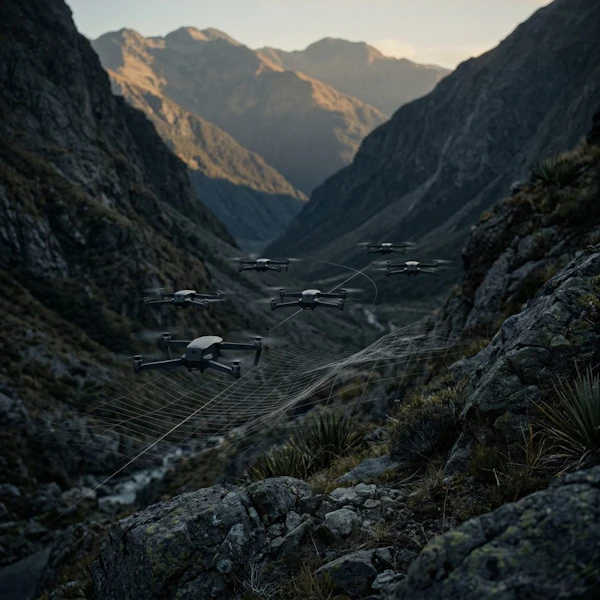
GNSS jamming and spoofing are now standard electronic warfare. From active theatres in Ukraine to Baltic shipping lanes to civilian airspace over Northern Europe, satellite navigation can no longer be treated as reliable infrastructure. Operators launch knowing the fix and the control link will degrade within minutes.
Most autonomous systems assume GPS is available. We assume it is gone.
Clausal builds terrain-referenced navigation that delivers bounded absolute position without GNSS. Multimodal sensor inputs are fused with inertial sensing to bound drift over long distances and difficult terrain. It runs on microcontroller hardware, at SWaP levels that fit platforms from small drones upward, and is designed from inception for mass production.
This is defence and dual-use work. The same stack goes onto multiple platform classes, from small uncrewed aircraft upward, all of it in contested environments.
We're a twenty-five head strong team in Helsinki. Clausal was founded by Tatu Ylönen, inventor of the SSH protocol, who built and took public SSH Communications Security and holds patents across AI, cybersecurity and aerospace. Engineering is led by Eero Jyske, who led the engineering scale-up at ICEYE as VP Software, was VP of Engineering at AlphaSense before that, and spent a decade in embedded engineering at Nokia. You'd work with both of them directly.
The team spans mathematics, machine learning, embedded software, hardware, systems engineering and supply chain: the disciplines it takes to ship serious autonomy on serious hardware. We've built at scale before, and we know the difference between a prototype and a deployable product.
The role
You'll be part of the team designing and training the neural networks at the centre of the navigation stack, the models that tell an aircraft where it is on the earth, with vision as the primary sensor and no prior fix to bootstrap from.
This is not SLAM. Relative pose is the easy half. The hard problem is absolute: acquiring geolocation from a cold start with no external aiding, then holding position against terrain for the duration of the mission, fused across vision and other onboard sensing. Then fitting all of it inside the memory and cycle budget of a microcontroller.
Positioning is where the work starts. It is not where it stops.
The role is deeply hands-on and the bar is high. You'll own models that ship onto flight hardware and get trusted in the field.
What you'll do
Design, develop and train architectures for vision-based absolute positioning: initial geolocation acquisition without external aiding, terrain-referenced positioning, place recognition and re-localisation, depth and terrain estimation.
Own the full model lifecycle, from problem framing and data strategy through architecture, training and evaluation to real-time inference on constrained embedded compute.
Make the accuracy, latency, robustness and SWaP trade-offs, and shape architecture decisions for the perception stack alongside flight controls, embedded and systems engineering.
Build for the tail rather than the average: low light, adverse weather, motion blur, obscuration, degraded and spoofed sensors. Failure behaviour is a first-class requirement, not a post-hoc concern.
Define how we measure success: evaluation datasets, metrics, and hardware-in-the-loop and flight-test validation that reflects real operational conditions rather than benchmark numbers.
Raise the bar around you. Mentor engineers, review architectures and training pipelines, deepen the team's practice in modern CV and deep learning.
Where the work expands
Absolute positioning is the foundation, and a hard enough problem to hold anyone's attention for a while. It isn't the whole of what runs onboard, and the roadmap beyond it is substantial.
We'd rather walk through that in person than publish it. What matters here is that how far you move beyond positioning is wide open, and depends on where your interests and judgement take the stack. We're hiring someone we expect to help decide what comes next, not just execute what's already planned.
What we're looking for
Substantial hands-on experience designing and training neural network architectures from the ground up. You can reason about why one architecture works and another doesn't, not just fine-tune what exists.
Strong applied computer vision: multi-view geometry, SLAM/VIO, depth and pose estimation, detection and segmentation, and the seam between geometric and learned methods.
Models shipped for navigation, localisation or perception on a moving platform, whether drones, robots, autonomous vehicles or similar.
Fluency in PyTorch or equivalent and the full training stack: data pipelines, large-scale training, evaluation, and debugging model behaviour.
Demonstrated experience making models run fast without a GPU: quantisation, pruning, and hardware-aware optimisation for constrained embedded targets. This is essential rather than a bonus.
Microcontroller experience specifically is rare and we don't require it, but the constraint should excite you rather than deter you.
Production experience over research fluency, though both is ideal. You've taken models into a fielded system and owned the outcome.
Curiosity about why something fails in the field, not just whether it passes the test.
Nice to have
Defence, aerospace, autonomy, or other safety- and mission-critical domains.
Multi-modal fusion across visual, inertial and other onboard sensing.
Hardware-in-the-loop, simulation and flight-test experience.
Publications, patents or open-source work in CV, deep learning or robotics.
The infrastructure
Training runs on our own compute in Finland, under EU jurisdiction. Training, synthetic data generation, evaluation and stress testing happen in-house, alongside a simulator and digital twin. No training data leaves European jurisdiction. That's the architecture, not a compliance workaround.
64× NVIDIA B200 / 16× A100 / 5,000+ CPU cores / 15+ PB storage / 400G internal fabric.
You won't be waiting on cloud credits or sharing compute with anyone else.
Where the work gets validated
Finland. Snow-covered terrain, low sun angles, dense canopy, extended low light, Arctic winter. Conditions most programmes treat as edge cases are our default test environment. The feedback loop runs from architecture to embedded target to field performance in a Finnish winter. If it works here, it works where it needs to.
Practical
Location: Helsinki, Finland. We work mostly in person.
Work authorisation: You'll need an existing right to work in Finland. We're a small team and aren't set up to sponsor visas at the moment.
Compensation: Salary plus equity.
Security vetting: Where the programme requires it, employment is conditional on Finnish security vetting through the Finnish Security and Intelligence Service.
How to apply
The application is short and we read every answer. A polished CV matters less to us than a clear explanation of what you actually built, what was hard about it, and what you learned. If there's code, hardware or published work that shows this, include it, as long as it's yours to share. Please don't send material belonging to a current or former employer.
We respond to everyone who looks like a fit.
Why join
Vision is the sensor of last resort. When the satellites are jammed and the link is gone, the model you built is what tells the aircraft where it is. Very few people get to work on absolute geolocation under this kind of constraint, and fewer still get to watch it fly.
The problem is real. The team is still small enough that early engineers shape what it becomes.
Perks and benefits
This job comes with several perks and benefits

Near public transit

Free office snacks

Paid holiday

Maternity / paternity leave

Healthcare insurance

Skill development
Working at
Clausal